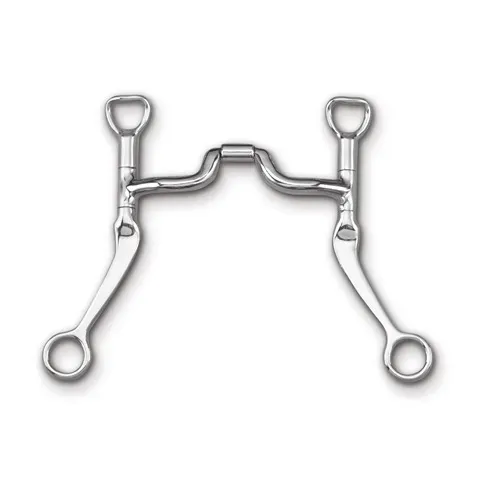
TheMB43LP mouthpiece is the mildest Level 2-3 Myler bite. The mouthpiece doesn't rotate down and put pressure on top of the tongue - instead, the gate is slightly narrower, but still leaves room for the tongue. Because the gate is narrower, the horse will feel a slight pressure on each side of its tongue when the bridle is pulled. The mouthpiece sits firmly on the horse's loins and lips, and because the gate is not as high, there will be little to no pressure on the palate. The MB43LP mouthpiece is stepped straight lead Level 3 Myler bits.
This bit is suitable for the discipline :
TheFlat Shank bit is a bar bit with 7" flat bars that curve slightly backwards towards the horse. The ring at the top of the cheek piece of the snaffle has a flat top, allowing the bit and snaffle to work harmoniously together. To prevent the bars from irritating or cutting the horse's cheeks, the bars have a slight angle - make sure you get the bars and bit turned the right way around when applying the bar bit. The curb bit must be used with a curb strap or curb chain, otherwise it has no effect. The curb strap or curb chain is placed in the same ring as the bridle. With a curb bit with a curb strap or curb chain, there will be long pressure in the horse's mouth, under the chin and in the neck - this allows for fine and calm communication between horse and rider.
Thehorse at Level 2-3 :
-
The horse has training equivalent to Level 2, but has a good temperament and can therefore benefit from a bite with more freedom of tongue.
-
The horse has training similar to Level 3, but requires more support and control as it is not ready for the freedom of the Level 3 bit.
-
The horse shows resistance and reluctance to the Myler Level 2 bites.
Independent Side Movement
Some of the Myler bits are equipped with so-called "Independent Side Movement". This is, as the name indicates, allows the rider to move each side of the bit independently of each other. This means that when the rider pulls on one rein, the horse gets a very clear signal as only one side moves. This provides effective shoulder control and bending of the horse.